All lose in different ways, a dam of corpses, towns of corpses, scattered across the sand. But whose, in what shares? Even the dealer doesn't know.
Forecast: A rain of blood will flood the desert and not purify it.”— The Forecaster, Fallout: New VegasThe Mojave Wasteland is the region synonymous with the pre-War Mojave Desert, spanning large portions of the pre-War states of California, Nevada, Utah, and Arizona. It serves as the primary setting and gameworld of Fallout: New Vegas.
Background[]
Compared to other parts of the former United States, the Mojave survived the Great War relatively unscathed. When the nuclear apocalypse began, 77 atomic warheads were launched at the city of Las Vegas and the surrounding areas, but intricate defense systems set in place by wealthy businessman Robert House resulted in 59 of the warheads forcefully disarmed mid-flight, another nine were blasted out of the sky by a laser defense system situated atop the Lucky 38 Hotel & Casino and the remaining nine hit the surrounding desert.[1]
The Mojave Wasteland's name had been coined by at least 2083, when one of its residents, Daniel Shin, was recruited into the Brotherhood of Steel by Knight Alan Connors.[2] Nearly twenty years later, the Brotherhood First Expeditionary Force passed through the Mojave on their way to Appalachia. Jack Cabot mentions that his father Lorenzo thought there was an alien city buried under the Mojave Desert, just like Ubar in Rub' al Khali.[3]
In the years immediately following the War, the Mojave was largely ignored by the developing post-apocalyptic civilizations, such as the New California Republic in the west and Caesar's Legion to the east, thus allowing raiders, slavers and super mutants to prosper there.[4] For years, Vegas sat at its heart, decayed by almost two centuries of neglect.
When NCR scouts reached Hoover Dam with the intent of expanding the NCR's borders, pre-War Securitrons rolled out onto the old Las Vegas Strip and rallied the three tribes occupying the city, at the behest of Mr. House, the man who had saved the city centuries prior.[5] In 2274, President Kimball sent the NCR army into the Mojave in force, with the objective of occupying and repairing Hoover Dam. With House's forces already occupying the dam and surrounding area, and the threat of Caesar's Legion looming ever closer, the NCR was forced to negotiate with House, resulting in the Treaty of New Vegas.[6] The clauses of the treaty allow for the NCR to send 95% of Hoover Dam's power output back to their home states, as well as granting them rights to establish military bases at the Hoover Dam and McCarran Airport. In exchange, Mr. House's New Vegas Strip retains its sovereignty and could receive the tourism of NCR citizens without interference from the government as well as the remaining 5% from the dam.[7][8]
Shortly thereafter, combined forces of the Legion's 86 conquered tribes arrived from the east, led by Caesar and the Malpais Legate, seeking a city to call their capital.[9] The Legion launched an attack on the dam and the NCR troops stationed there but were repelled and forced back east. Most of the credit went to Chief Hanlon for issuing a tactical retreat to Boulder City and luring the Legion into a trap laid by the NCR Rangers that leveled half of the town, then routing the surviving Legionaries back across the dam. This ultimately led to the attempted execution of the Malpais Legate. The outcome of the battle solidified the delicate balance of power in the Mojave; between the NCR, Legion, and House, should one attack the other, the third could take advantage of the conflict and attack in turn.
Layout[]
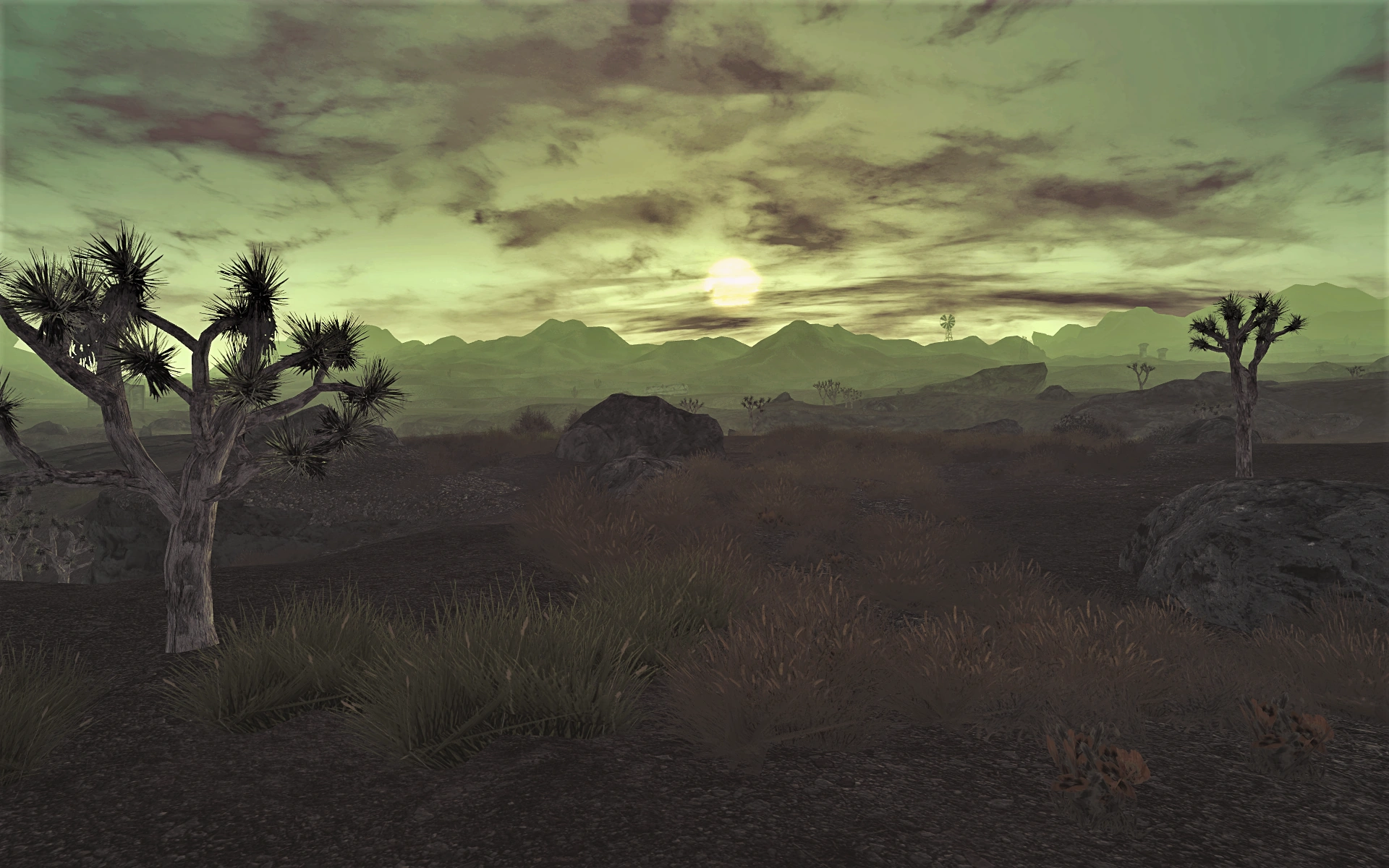

The Mojave Wasteland has significant diversity in terms of inhabitants and landscapes. In the northwest, the super mutant and nightkin-friendly settlement of Jacobstown overlooks the valley from the snow and pine-covered mountains. To the west, the Great Khans have settled in the vibrant cliffs of Red Rock Canyon. The independent settlements of Goodsprings and Primm sit amid the encroaching New California Republic from their Mojave Outpost and the Powder Gangers, a group of escaped convicts, from the NCR Correctional Facility and surrounding camps. The forces of Caesar's Legion are slowy seeping east across the Colorado River at all possible junctures, from their mainstay at the Fort, the newly captured town of Nelson, the destroyed settlement of Nipton and Camp Searchlight, a former NCR stronghold sabotaged by means of radiation. Their forces gather strength each day, readying themselves for a second offensive against the NCR for control of the much-coveted Hoover Dam.
The central region hosts tall and imposing mountain peaks with accompanying valleys, one of which shelters the remainder of the area's Brotherhood of Steel chapter. A group of deranged super mutants and nightkin have taken residence on the foremost peak of Black Mountain. The independent settlement of Novac struggles with neighbors consisting of irradiated abominations, while businesses such as the Gun Runners, Crimson Caravan Company and the 188 Trading Post traders attempt to keep commerce viable amidst the growing chaos.
Fringe groups in settlements circling the middle of the region, such as the Kings and Followers of the Apocalypse in Freeside, citizens of North Vegas Square and Westside, all actively exerting their independence while supporting and sheltering those who call the neighborhoods home.
In the center of it all, the glowing jewel of the desert, the New Vegas Strip's casinos light up the night sky, contently continuing business as usual by attracting those who wish to partake in the allure of riches. Yet similar to the surrounding powers that be, also quietly fortifying itself as a power against all those who may attempt to breach its walls is the secretive benefactor of the beautiful city itself.
Regions[]
West[]
The northwest-southeast side of the Las Vegas Valley south of the border with California includes the Southwest Commonwealth Conservation Area, encompassing Red Rock Canyon. Examples of locations within this region are Goodsprings, Devil Peak, Mummy Mountain, Mount Charleston, Red Rock Canyon and Vault 22 along Nevada State Route 157 and Nevada State Route 159. Locations such as Floyd Lamb State Park and the Corn Creek Dunes are situated in the foothills of Mount Charleston along Highway 95.
New Vegas Valley[]
This New Vegas basin area is surrounded by mountains to the north, south, east and west of the main metropolitan areas of the region. Frenchman Mountain and Lake Mead are located to the east. Locations include the New Vegas Strip, Camp McCarran, Freeside, Westside, Vault 3, Nellis Air Force Base at the northeast corner of the valley, and Camp Golf and Lake Las Vegas in the southeast.[10]
Interstate 15 traverses through Jean before descending into the valley, entering the semi-rural South Vegas area. After passing the Strip, the road elevates and turns northeast, continuing through Freeside until turning sharply north before reaching Nellis Air Force Base towards Garnet.
Highway 95 enters just northwest of the 188 Trading Post and follows the course of the valley. First traveling northwest through Henderson until where it elevates and continues northeast, skirting Frenchman Mountain (which contains Vault 34) until it abruptly turns northwest. From there it continues over the north Vegas suburbs until, just before Freeside, it descends to ground level and merges into urban Vegas.
Central[]
The McCullough Range runs parallel to both Interstate 15 and the main railroad system of the region. It is surrounded by three areas, the New Vegas Valley which lies to the north, the Ivanpah Dry Lake to the west and the El Dorado Dry Lake to the east. Traversing the range is Nevada State Route 164 which begins in the Ivanpah Valley and ends in Searchlight. Locations include Nipton, Black Mountain, Jack Rabbit Springs, Primm Pass, scorpion gulch, Wolfhorn ranch in the foothills and the REPCONN test site.
The Ivanpah Valley features several locations including Primm, Jean Sky Diving, Sloan, Hidden Valley and the Ivanpah Dry Lake. To the northwest of the valley is the Mesquite Mountains and the mining towns of Sandy Valley and Ripley.
Opposite of I-15 is the Mesquite Mountains crater, canyon wreckage to the Divide and the Mojave Outpost. The outpost is built along Interstate 15, which traverses the mountain pass heading into California. At the foot of the mountains is NV-164 which passes through Nipton into Nevada.
East[]
Highway 95 traverses the valley parallel with the Colorado River and meets Highway 93 at the 188 Trading Post, connecting Boulder City to Henderson. Locations include the El Dorado dry lake, Vault 11, HELIOS One and Novac. The region stretches all the way from Camp Searchlight to the Hoover Dam and contain locations such as Boulder City, Nelson, Techatticup Mine and the Lucky Jim Mine and the abandoned Brotherhood of Steel bunker. Parallel with Highway 95, Ranger Station Charlie, Legion raid camp and the broc flower cave are situated in a valley. This valley connects HELIOS One with Nevada 164, running parallel with Highway 95 along the powerlines.
Lake Mead and the Colorado River[]
The Colorado River flows from the Rocky Mountains southwest across the Colorado Plateau and through the lower end of the Grand Canyon before widening into Lake Mead, formed by the construction of the Hoover Dam. U.S. Route 93 passes over the Hoover Dam into Arizona. The river passes Willow Beach and Cottonwood Cove where it continues past the Cottonwood crater and Dry Wells.
Flora and fauna[]
According to Chief Hanlon, the state that was once Nevada is more fertile and has more water and foliage than California, as the population in California has exploded and caused the need for expansion east in search of new opportunities and land.
A large number of native and familiar species have continued to thrive in the Mojave Wasteland. A variety of birds including ravens are seen in the wastes, pecking through debris and vegetation for food. Fish are present in Lake Mead and the Colorado River. Coyotes have managed to survive in the wasteland with little to no mutation. Despite this, the Mojave wastes are still peppered with mutated species, such as bighorners, brahmin, radscorpions, night stalkers and cazadores, with the last two a result of experimentation at Big MT.
Nevada agave fruit grow in abundance, as do banana yucca fruit. The ever-present radioactive fallout has still altered some of the native life, with glowing mushrooms a common sight. Snow is also present in the area. Water encountered throughout the Mojave is safer to drink and some instances are free of radiation, plant life is found consistently throughout the area and various animals are encountered on a regular basis, thriving in the mostly undisturbed lands.
Inhabitants[]
Because only nine warheads hit the surrounding areas around the Mojave, rebuilding society has been less challenging than in other parts of the country. Many portions of the wasteland have remained untouched by humans since the Great War (such as Vault 22 and H&H Tools Factory), while others have been resettled (such as Freeside and Novac). The pre-War buildings and factories are more intact, allowing businesses such as the Gun Runners and Michael Angelo's workshop to continue to run and operate. Technology is more well preserved, thanks to the lack of nuclear fallout, and items such as the neon signs that dot the New Vegas Strip, the monorail within Camp McCarran, or the massive generators of the Hoover Dam, have been repaired to proper working order.
Everyday society is stable in some areas and not in others. While small-time traders and traveling merchants along Highway 95 and the Long 15 are able to operate, it is a fraction of what the larger and more organized traders and caravans are capable of. The larger entities have the advantages of manpower and firepower, and those that have managed to acquire pre-War technology, such as the Crimson Caravan Company, prove even more successful, some even recruited out of the region to serve with military organizations elsewhere in the pre-War United States.[11]
Super mutants are less common here than other parts of the country, and most who are residing in the area have chosen to do so in their own community of Jacobstown or the more hostile Black Mountain. Composed of remnants of the former Unity, they are considerably more intelligent than their Vault 87 and Institute cousins, though nightkin ail from severe psychological damage.
Separating New Vegas from the rest of the Mojave exists a vast expanse of desert where many dangerous creatures such as deathclaws, feral ghouls and radscorpions thrive. This generally causes most travelers to traverse along NCR-controlled highways or hire mercenaries to escort them.
Casinos and gambling are popular among the locals in the area, making the New Vegas Strip a popular hub of activity for merchants, caravans, NCR troopers, opportunists and everyday people wanting to hit it big at the slots. The main casinos, The Tops, Gomorrah and the Ultra-Luxe, are run by the three tribes that settled in New Vegas. Each has its own personal rules and customs, other than the universal rule against carrying weapons into their casinos, and are overseen by Mr. House and his Securitrons.
Politics[]
Politics play a large role in the society of the Mojave. Politics in the region boils down to three major powers: the NCR, Caesar's Legion and the Free Economic Zone of New Vegas controlled by Mr. House. The NCR is finding its war with Caesar's Legion both increasingly unpopular back in California and expensive to fund. Caravans and merchants heading to and from the Mojave deal with exorbitant taxes and fees imposed on them by the NCR. Caesar's Legion is coming ever closer to finding out what happens when their absolute ruler, and god, finally passes away and is facing the question of what truly unified the Legion in the first place, Caesar's ideals or Caesar himself. The casinos on the Strip have their own agendas and Mr. House has his own mysterious plans for the Mojave and more specifically, the Strip.
The NCR's goal in the region is to annex the Strip as an NCR territory and completely settle the region as NCR land. Many NCR soldiers and former soldiers, such as Craig Boone, believe this is not possible until the NCR takes the fight to the Legion and takes out Caesar himself; only then will the NCR be an unchallenged power in the region and able to safely settle without danger of constant attack. This sentiment is brought on by the commanding officer in the region, General Lee Oliver, constantly ordering his forces to hold the line, despite objections from his subordinates such as Chief Hanlon, Colonel James Hsu and Major Dhatri. They feel that the position the general is putting them all in, holding the line against the Fiends, ordering Chief Hanlon not to pursue the Legion at the First Battle of Hoover Dam or ordering the NCR Rangers into a support role when they have more skill than the NCR's heavy troopers, are racking a higher body count than would actively pursuing an offensive campaign against these opposing entities, which each one feels the NCR is capable of doing.
The Legion's goal is to make the Strip its new capital, replacing Flagstaff to the southeast. It also desires complete control of Hoover Dam as it is a strategic position to defend and a source of clean water. They are less interested in the power the plant provides as they reject advanced technology, believing it a crutch rather than a tool to be used. The Legion, despite a devastating defeat at the First Battle of Hoover Dam, has once again emerged from the east and actively attacks NCR outposts and camps from its base at Cottonwood Cove. Camp Forlorn Hope is an excellent example of how the Legion has regained strength, as they took the nearby city of Nelson and repeatedly assault the camp, lowering morale among the camp's inhabitants. Once the Legion takes a position, they seem to be able to hold it effectively, without much resistance. This is the opposite of the NCR, which is constantly losing footholds in positions in the eastern Mojave.
Meanwhile, Mr. House fortifies his position on the Strip, letting the conflict between the NCR and the Legion play out. He believes that the fewer soldiers of each organization who try to impede his progress at the next battle of Hoover Dam, the better. He patiently bides his time, waiting to exploit vulnerabilities generated by one faction attacking the other as a constant backdrop of distant explosions, artillery and gunfire can be heard regularly throughout the region.
Appearances[]
The Mojave Wasteland appears only in Fallout: New Vegas and is mentioned in Fallout 4 and in Fallout 76 as of the Steel Dawn update. The Mojave also appears briefly in the finale of season 1 of the Fallout TV series.
Behind the scenes[]
- The Mojave Wasteland is based on the real world Mojave Desert, stretching across equivalent portions of the states of Nevada, California, Arizona and Utah.
- The sky in the Mojave is astronomically correct. The Moon changes phases each day according to the month.
- Developer quotes
- The Mojave Wasteland map as seen in the Pip-Boy features a larger scale than the map of the Fallout 3 Capital Wasteland and the actual play area is similarly larger. A single map cell on the Fallout: New Vegas map is subdivided into 16 cells, whereas the same cell on the Fallout 3 map is subdivided to just 9 cells. [12]
- Question: "In F:NV almost half of the map is unused. A huge "border" on the left, and significant borders on the right and upper part. Next time i suggest to crop it, cause that's a torture for players who loves to explore. Guess you didn't have time to build there."
Joshua Sawyer: "We built our map following natural features of the Mojave Desert extrapolated from USGS topographical data. The Mojave Wasteland is pretty close to the Capital Wasteland in overall tiles. When people compare the two and conclude that the Mojave Wasteland is tiny compared to the Capital Wasteland, it's sort of odd. It's the equivalent of comparing two non-scale-equivalent maps of California and Colorado and concluding that Colorado is larger than California because the map occupies more pixels in a square encapsulating it. We tried to alleviate this disconnect in Honest Hearts by putting a dotted line around the outer wall of Zion Valley. Like the Mojave Wasteland, Zion Valley was also constructed by using USGS data as a starting point."[13] - Question: "The Mojave Wasteland is pretty close to the Capital Wasteland in overall tiles" Yes, but all the artificial walls in the middle make it feel smaller: you're funneled into corridors with which you become very familiar. Free roam would've solved this.'
Joshua Sawyer: "It would not have solved line of sight issues. The Mojave Wasteland has deeper valleys/higher mountains than the Capital Wasteland, so in some cases the highest points of ostensibly walkable terrain overlook areas that look bad from a high vantage point. This was the first time any of us had used this technology, so many of the best practices for building only became apparent in retrospect, unfortunately. Were we to build the Mojave Wasteland again, we would make different choices in how to lay out the areas. Some of this can be seen in Zion Valley. The only collision blockers we used on that map were to prevent people from getting stuck while dropping down from higher elevations. ScottE and the other world builders put a lot of effort into making sure that people could scale anything on the interior of the valley, and the outer cliff faces tower far above the rest of the terrain."[13]
Gallery[]


References[]
|